
Vineyard · June 15, 2026 · 3 min read
How We Laid Out Three Acres
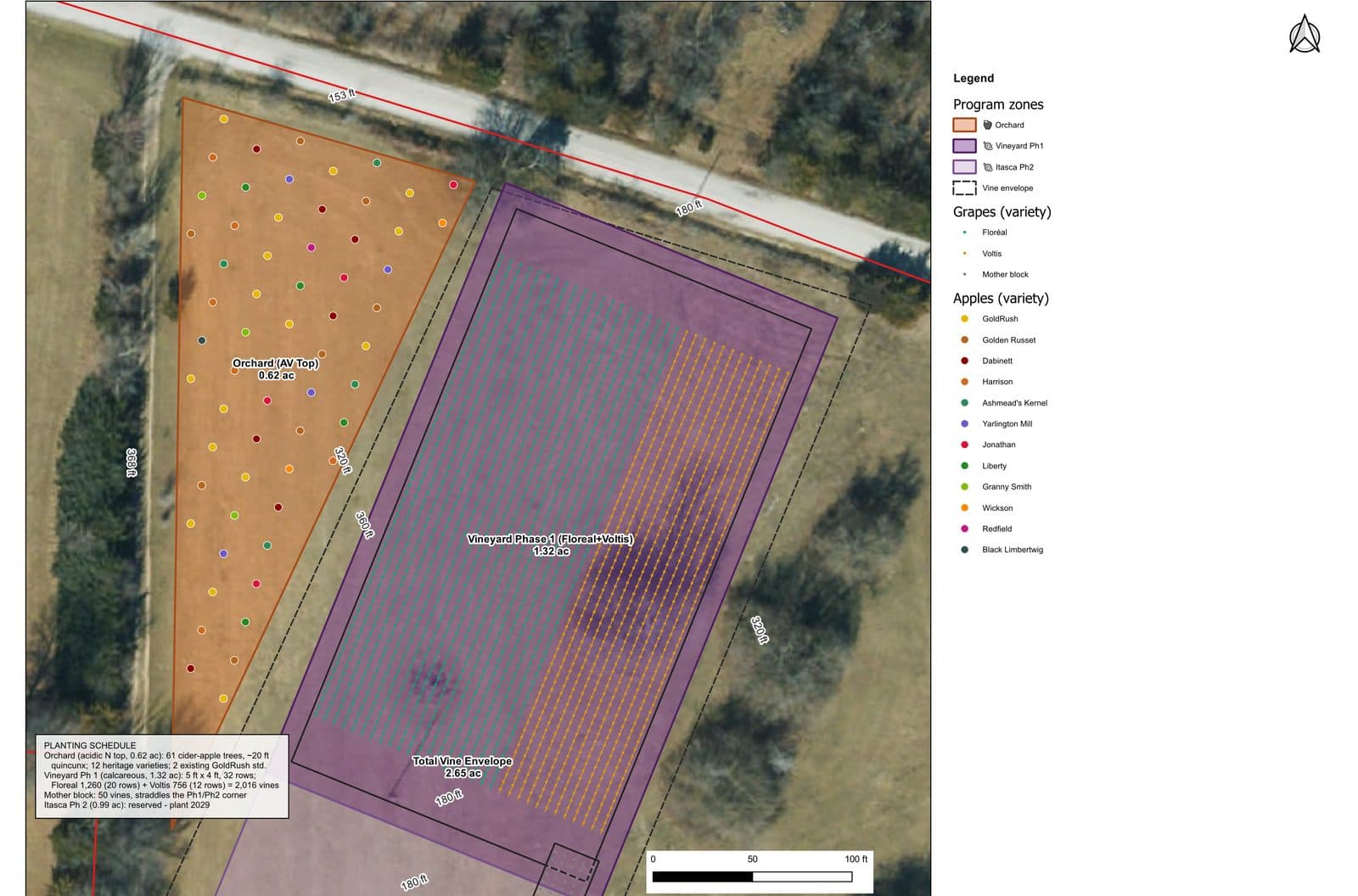
We have roughly three and a half acres to work with in Western Missouri, on a southeast slope over fractured limestone. Before we put a single vine in the ground, I wanted the entire estate laid out, every row, every vine, every tree, with real coordinates. So the whole thing is mapped now. 2,066 vine positions, 61 tree positions, 32 rows. I can tell you where vine 1,407 will be to within a few inches. I am not normally OCD about most things, but after visiting Bella Winery last November and touring their Trott and Follow Vineyard, planted pre-Prohibition, I realized we need to be precise. If you have not been, their cellar is amazing, and their Director of Winemaking, Ryan Schmaltz, is an excellent, knowledgeable fella who carries the history of some of the oldest vines in America.
The soil made the first decision for us
We ran a three-point soil transect down the slope last spring, and it came back two different worlds in one field. The top of the slope holds some of the deepest soil on the site, a good four feet of it, and it runs acidic, pH 5.9. The middle and bottom are the opposite: much thinner topsoil with fractured limestone exposed at the surface, more slope under your feet, and calcareous chemistry, pH 7.0 to 7.2, organic matter near six to seven percent, calcium saturation above ninety percent.
So the land is zoned the way the soil says, not the way a drawing would look tidiest:
- The north wedge, the deep acidic top, is the orchard. Apples are happier there than vines would be, and cider is co-equal with wine in this house anyway.
- The calcareous middle is Vineyard Phase 1. Thin soil, exposed fractured limestone, real slope. This is where the limestone does its work. Floréal and Voltis go here.
- The south block is reserved for Itasca, Phase 2, in 2029. Almost another acre of the same calcareous ground, and it sits empty until the first blocks teach us something.
Five feet by four feet, and what that commits us to
The vineyard is 32 rows, each 250 feet, at five feet between rows and four feet between vines. That is 2,178 vines per acre, roughly double the density of a typical Midwest vineyard.
Tight spacing is a chain of consequences, and we chose it with eyes open. Smaller vines, in balance. More vines competing for the same water and nutrients, which for sparkling is the point, we want tension, acid, restraint, not jungle. And five-foot rows mean no standard farm tractor will ever fit between them. Every piece of equipment we buy from here on is dictated by that one number.
Phase 1 is 1,250 Floréal on the west side and 750 Voltis on the east, in whole rows, twenty rows and twelve. A fifty-vine mother block sits at the corner where Phase 1 meets the Itasca reserve, half in each, which felt right, the nursery stock straddling the present and the future.
The orchard is a staggered grid
The 61 cider apple trees on the north wedge are set in a staggered diamond pattern, four corners and a center, like the five-side of a die, the way orchardists have planted for centuries. Twenty-foot centers, twelve varieties, from GoldRush to Dabinett to Harrison, spread through the grid so no variety clusters and pollination has no dead zones.
There is a deliberate gap between orchard and vineyard. Wasps love dropped apples, and dropped apples happen at harvest. Our sparkling harvest comes early, before peak wasp pressure, but the buffer costs us nothing and I would rather design the problem away than fight it every September.
Things are getting exciting...
More to come.