
Western Missouri
The vineyard.
Limestone, slope, and hedges on the western and northern flanks that buffer Midwestern weather.
The Land
A fractured limestone shelf.
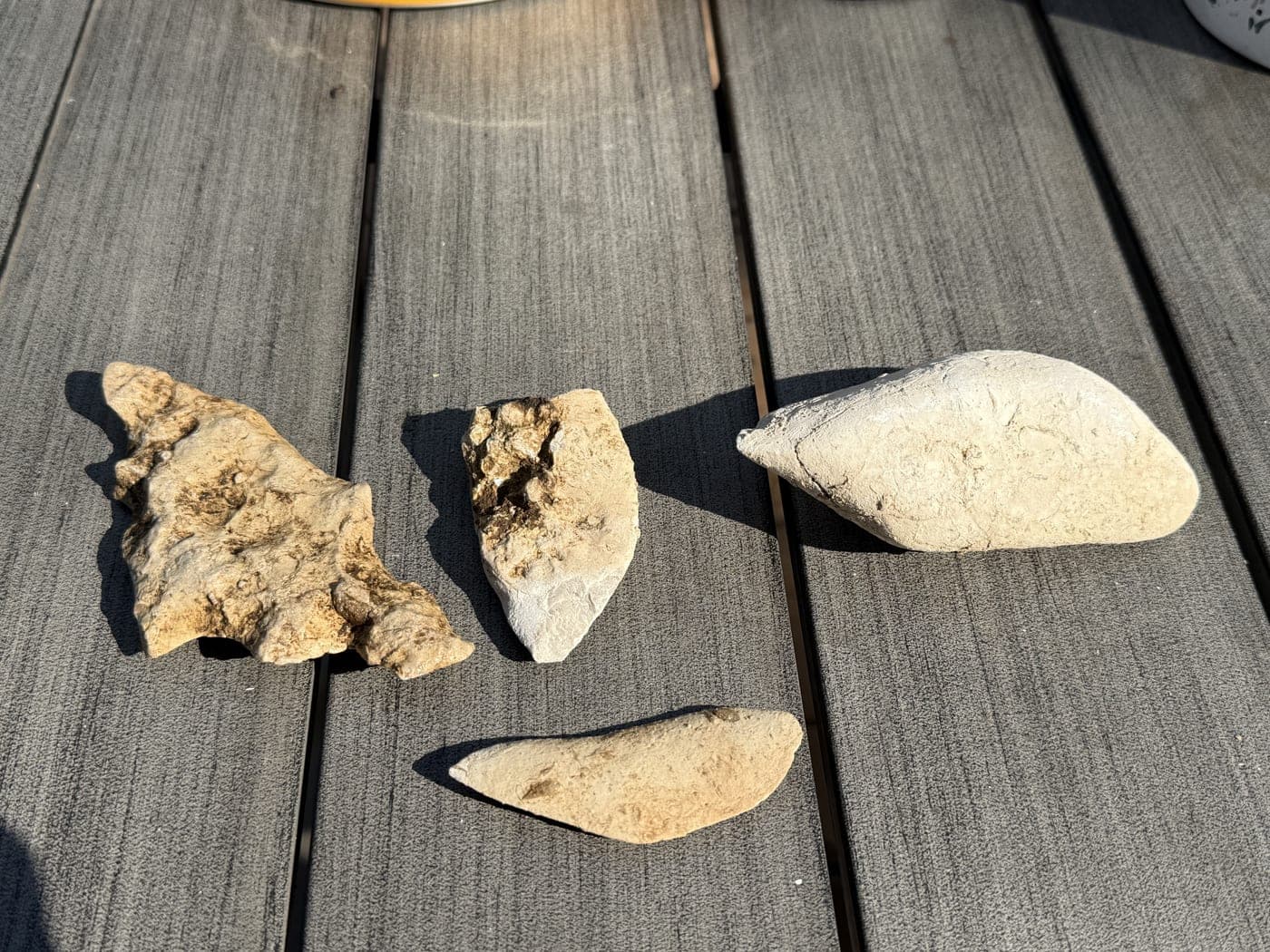
We're planting on an east-northeastern slope on a fractured limestone shelf in Western Missouri. Limestone bedrock rises close to the surface here, the kind of geology that gives Burgundy's Côte d'Or and the Loire's tuffeau their famous tension and minerality.
The site has natural hedge buffers on its western and northern flanks that take the brunt off Midwestern weather, well-draining soils, and an aspect that favors morning sun and gentle afternoon. None of this is luck. It is what we looked for.
Why Limestone
A bedrock thesis.
Limestone retains water without becoming heavy. It moderates the vine's vigor. It contributes calcium ions that lift acidity, brighten aromatics, and, most importantly for sparkling, create the tense, low-pH base wines that méthode traditionnelle is built on.
Most Missouri wine is made on rich, alluvial soils. Ours isn't. That's the point.
The Site
Slope, drainage, frost.
The shape of the land is half the story. Cold air drains downslope away from the planted blocks at night, reducing frost risk during budbreak. The east-northeastern aspect gives morning sun to dry dew quickly, cutting fungal pressure before it starts.
This is the calculus of site selection: every degree of slope, every direction of aspect, is a vote for or against the vines.
What's Planted
Floreal, Voltis, Itasca.
Three disease-resistant hybrids, PIWIs, bred specifically to thrive without the spray load that vinifera demands in Missouri's humidity. Floreal and Voltis are French INRA selections with stacked Rpv and Run resistance genes. Itasca is a University of Minnesota cold-hardy hybrid. All three sit beautifully on limestone and produce the bright, low-pH base wines we want for sparkling.
The scions are grafted onto 420A rootstock, a Vitis berlandieri × Vitis riparia cross chosen for two reasons specific to this site. It tolerates the high active calcium carbonate that the limestone shelf provides, where many rootstocks would suffer iron chlorosis. And it moderates vigor, keeping the vines in balance and the fruit concentrated rather than diluted by overgrowth.
We're training and pruning by Simonit & Sirch guyot methodology, the European school built around vine longevity, vascular health, and multi-decade trunk integrity. We are planting for our grandchildren.
The Orchard
Apples on the same limestone.
Cider has been the longer endeavor here than wine, and the orchard is no afterthought to the vineyard, it is co-equal. The same limestone that gives our base wines tension feeds the apples too. The orchard is being planted as a blending system, not a monoculture, and not as a side hustle.
- GoldRush, acid and longevity
- Dabinett & Yarlington Mill, tannic structure (English bittersweet tradition)
- Harrison & Franklin, American heritage cider apples
- Stayman, Grimes, Golden Delicious, balance and aromatic lift
Read more about the cider program on The Method, and in the journal at How the House Starts.
The Animals
Sheep, goats, and the soil.
Regenerative organic farming, with livestock integration. Sheep graze the cover crops between rows. Goats handle the brush at the edges. Their manure feeds the soil. Their work replaces tillage. Their presence is what makes regenerative organic farming on a Missouri vineyard not only possible but cohesive.
We aspire to Regenerative Organic Certified (ROC) standard. The path is long. The path is right.
Where We Sit
The neighborhood.
Missouri once made more wine than any state in America. Augusta, two hours east of us, became the first federally recognized American Viticultural Area in 1980, before Napa. German immigrants tended vines on Missouri river bluffs decades before California's wine industry got serious. Prohibition gutted that history, and what remains is rebuilding. We are part of that rebuilding, and we are happy to be.
Our site sits about fifty miles northwest of the Ozark Highlands AVA, which cuts off at Nevada, Missouri. Limestone shelves like ours don't follow AVA borders, and unclaimed ground gives us room to define what serious sparkling from this latitude can be, without the constraints of someone else's tradition.
We are not isolated either. A cluster of established wineries sits directly across the Kansas line in Johnson and Miami Counties, and Kansas City has been one of the more discerning American wine markets for decades, anchored by serious sommeliers and restaurants. We are at the edge of a regional wine community that already exists, and we intend to add to it.
From the Journal