
Place · October 3, 2025 · 4 min read
Missouri and Our Opportunity for Grape Growing
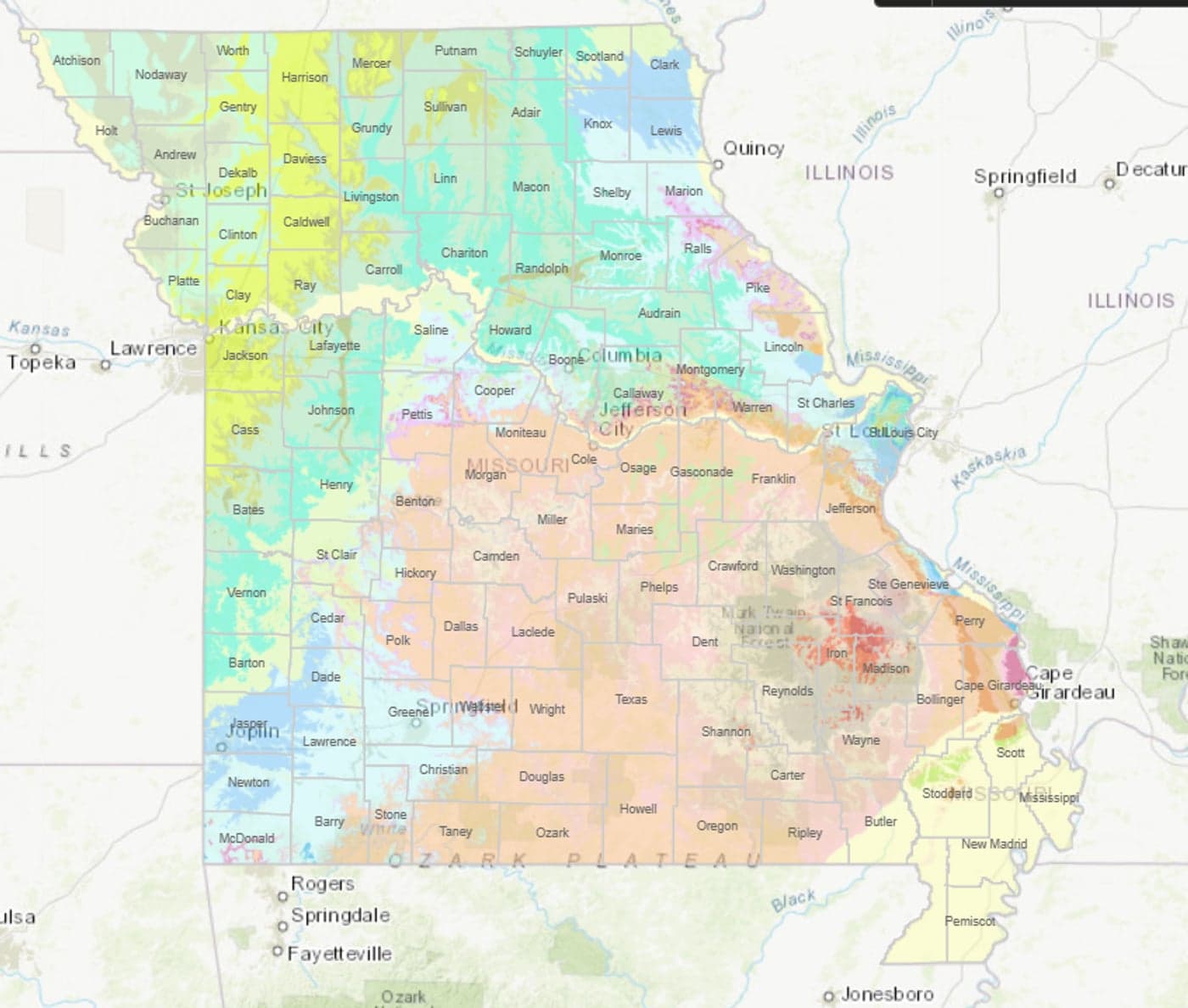
Dissimilar to California, America's most recognized and productive wine state, Missouri sits at a crossroads of climate, culture, and geography. This has been true since the days of Manifest Destiny, when Daniel Boone settled west of St. Louis, when German immigrants moved into the Missouri River valleys and northern farming plains, when Dutch from Appalachian towns pushed into the Ozarks, and when my own ancestors left Asturias, Spain to work in Missouri's zinc and lead mines. They encountered the same climatic obstacles we still face today: vicious storms, flooding, hot and humid summers, and bitter cold snaps in late January and February.
North of the Missouri River, the land lies relatively flat, covered with loess and other well-draining soils practically engineered for row crops. To the south, the Ozark Plateau rises, rugged and rocky, marked by limestone outcrops, karst springs, and forested hills. The landscape is striking, showcasing limestone bluffs standing over wide rivers, rolling pastureland broken by old oak and hickory stands, and natural springs gushing millions of gallons creating cold, clear rivers.
It was this blend of natural beauty and agricultural promise that encouraged German settlers to put down roots. Missouri reminded them of the Rhineland, the motherland. In fact, Gottfried Duden, writing in the 1820s, explicitly observed that "grapes from the Rhine would do very well in Missouri" (Augusta Report, pp. 4). Later settlers confirmed this: the river bluffs around Augusta and Hermann bore more than a passing resemblance to the vineyards above the Rhine and Mosel. The climate, the soils, and the opportunity for expansion all aligned.
And they were correct, Rhine varieties could grow here. But unlike in Germany, where the Rheingau and Rheinhessen average mild summers barely topping 80°F (26°C), with only an inch or two of rain each month, Missouri's growing season offers the inverse: hot days consistently in the 85–95°F (29–35°C) range, 2.5–4.5 inches of rainfall per month (3.3 so far in September), and nights where the thermometer hovers between 80–85°F with 90%+ humidity and not a breath of wind. Our challenge is not ripening, it's managing everything else.
But here's the opportunity: the global wine industry has spent the last century solving problems just like ours.
- Humidity & rainfall: Bordeaux, New York's Finger Lakes, Brazil's Serra Gaúcha, and Japan's Yamanashi Valley all contend with excessive humidity and rainfall during the growing season. They've developed fungicide regimes, canopy management, and hybrid breeding programs to cope, plus Missouri's limestone marl and bedrock allow for good fast drainage.
- Heat: Spain's La Mancha, Portugal's Alentejo, and southern Italy all know what relentless summer sun means. Advances in drought-resistant rootstocks, trellis orientation, and soil management help moderate vine stress. Missouri, by contrast, rarely has to worry about under-ripeness, an advantage in the modern climate era.
- Frost: Chablis, Saale-Unstrut, New York, Champagne, and Northern Michigan fight frost every spring. Their strategies (frost fans, smudge pots, site selection, and slope orientation) are directly applicable here.
Closer to home in America, California's growing issues are not ours. They wrestle with drought, wildfires, skyrocketing land costs, restricting regulation and taxation, and shifting climate zones. Missouri's issues are different: too much water instead of too little, too much humidity instead of cloudless skies, unpredictable frost windows instead of ever-lengthening summers. But unlike California, land in Missouri remains accessible, water is abundant, and energy inputs are lower. If anything, Missouri's challenges are more about persistence and timing than an existential threat. We understand the challenges and have mitigation techniques available.
The opportunity in Missouri is to take advantage of this middle ground. With hybrids bred in European and American labs, disease-resistant rootstocks, and century-tested spray programs. With proper targeted planting on slopes, aligning rows to maximize air flow and morning sun, we can mitigate frost. With canopy management and scheduling, we can get sprays on in between rains. Plus, with cold-season vineyard practices, from hilling up to pruning late, we can push European varieties further than previous generations imagined.
Where the Germans saw the Rhineland, we can see the opportunity for the revitalized Midwestern American wine frontier. Missouri is not California, and that can be a strength and an opportunity to shape something distinct and our own: a wine culture forged from known adversity, limestone, water, and sun, with an echo of the Rhineland but rooted in the American heartland.
Reference: