
Vineyard · July 21, 2026 · 5 min read
What Showed Up in July
Last month I wrote about how the estate is laid out, every row and every vine with real coordinates. That was the easy part, honestly. Drawing is free. July was the month the drawing started costing money, and the month the plot stopped looking like a hayfield with an idea attached to it and started looking like a place where something is about to be built.
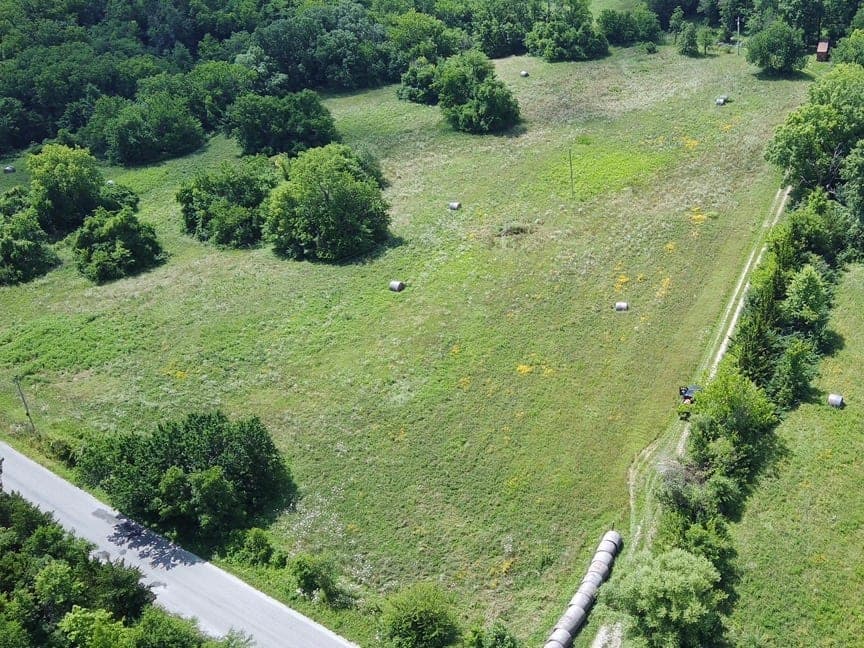
The posts
The first thing to arrive was the posts. On June 26 a flatbed backed up the drive and left a hundred and fifty of them in a stack at the edge of the field, eight-foot CCA-treated posts, six inches across, and that stack was the first physical proof that Phase 1 is real. Thirty-two rows at 250 feet means 128 end and brace posts, so this covers the heavy posts with a few spares, and the T-posts and cross braces to hold the wire come next. That is a lot of treated wood sitting in the grass, and it made me look at the slope differently. You can talk about a vineyard all you want. A pile of posts is a commitment.
They came from a farm auction just south of Harrisonville, about ten miles from the plot, where a farm had turned over and everything went on the block. The whole lot was $750, a fraction of what the same posts would run new at the farm store, and a reminder that around here the best equipment prices are usually somebody else's ending.
The sprayer
Then the sprayer. It is a Pak-Blast, a compact three-point air-blast sprayer with a 50-gallon tank, and I found it at another farm auction, this one in Iowa just east of Omaha. A vineyard owner there had retired and closed up shop, and the sprayer went for $500. It needs a few plastic fittings and two hoses replaced, and the Pak-Blast team sent over the maintenance manual and have been answering my questions, so it will be ready well before there is anything to spray. Fifty gallons is the right size for a two-acre starter site. I had been watching for one for a while, because the row spacing we chose last month, five feet, rules out most of what the used market has to offer. A standard orchard blast sprayer will not fit between our rows any more than a standard tractor will. The Pak-Blast is narrow enough, and it is built for exactly this kind of high-density planting.
I want to be clear about what the sprayer is for, because I have written a lot here about PIWIs and regenerative organic and doing less. Disease-resistant varieties do not mean no spraying. They mean far fewer sprays, and organic-approved materials instead of the conventional program I described in some of the older posts. Floréal and Voltis carry stacked resistance genes for downy and powdery mildew, but Western Missouri humidity is relentless and a young vine has no margin. The sprayer is the insurance policy that lets the genetics do the work.
It rode home from Iowa in the bed of the truck on June 23, and it barely fit. My neighbors have opinions about what I keep bringing home.
The tractor hunt
Which brings me to the tractor, or the lack of one. Five-foot rows mean a tractor no wider than about four feet, and that is a narrow-vineyard machine, not a Missouri farm tractor. I have spent more evenings than I would like to admit looking at listings for narrow compact tractors, the kind built for orchards and European vineyards, and I have not bought one yet. Everything with the right width is either three states away, or has an engine older than I am, or costs more than a used car.
That is the honest cost of the density decision. I said last month that every piece of equipment from here on is dictated by that one number, and July was the month I found out what that means in dollars and in hours on Craigslist.
The cellar side
The vineyard got most of the attention, but the cellar started filling up too. Two 400-liter stainless steel tanks, with tri-clamp fittings, so every hose, valve, and pump connection is a sanitary quick-connect instead of a threaded fitting and a prayer. Hoses to go with them. A set of large bins for moving fruit from the picking site to the winery without crushing what is on the bottom, because for sparkling the fruit needs to arrive whole. And the small things, glass funnels and beakers, that do not sound like much until you are trying to measure a tirage dose at eleven at night with a kitchen measuring cup.
Two 400-liter tanks is 800 liters of capacity. That is small, deliberately. Everything in this house is going to be bottle-fermented, so the tanks are for base wine and base cider, not for storage, and I would rather have two clean small vessels I can keep separate than one big one that forces me to blend before I am ready. Volume is easy to add later. Habits are not.
What it adds up to
Posts in a stack, a sprayer in the barn, two tanks in the cellar, and a tractor still on the wish list. None of it is glamorous. All of it is the difference between a vineyard on paper and a vineyard.
More to come.